Defect Detection
-
Scratches, cracks, dents
-
Flash and short shots
-
Voids and missing material
-
Debris and contamination
-
Cosmetic defects

Classification
-
Good/bad sorting
-
Defect classes
-
Part recognition
-
Assembly states
-
Visual decisions

Assembly Verification
-
Clips and fasteners
-
Connectors and inserts
-
Labels and seals
-
Wrong-part detection
-
Orientation checks

Measurement
-
Length, width, height
-
Hole spacing
-
Gaps and offsets
-
Angles and slopes
-
Tolerance checks

OCR & Code Reading
-
Serial numbers
-
Lot and date codes
-
Barcodes and 2D codes
-
Label validation
-
Part ID matching

Data Capture
-
Image storage
-
Timestamps
-
Part and job IDs
-
Pass/fail records
-
Model versions

PLC Communication
-
Discrete I/O
-
Ethernet/IP
-
Modbus TCP
-
PROFINET
-
Trigger handshakes

Runtime Sequencing
-
Job selection
-
Machine states
-
Fault handling
-
Cycle logic
-
HMI feedback

Robotics Integration
-
Pick and place
-
Part localization
-
Robot-presented inspection
-
Camera-on-robot
-
Motion-timed capture

Cameras & Sensors
-
Camera selection
-
Lens selection
-
Lighting control
-
2D and 3D sensors
-
Thermal/spectral sensing

Fixtures & Test Hardware
-
Nests and mounts
-
Shrouds and enclosures
-
Poka-yoke tooling
-
Breakout boxes
-
Test connectors

Deployment Support
-
Installation
-
Commissioning
-
Validation
-
Training
-
Troubleshooting

Our Approach
LM3’s inspection strategy follows a tiered, cost-conscious process that prioritizes efficiency without compromising performance. We begin with AI-based inspection using QC Hero, the fastest and most cost-effective approach for most applications. If additional accuracy or functionality is needed, we scale into rule-based vision tools, precision optics, or 3D imaging, only when justified. This stepwise methodology ensures clients receive solutions that are technically sound, financially optimized, and fully aligned with production goals—delivering the right technology at the right price.
2D Vision and AI
Traditional Vision
3D and Advanced Optics
Hybrid Intelligent Systems
Our systems are built to scale, whether deployed as a single inspection point or a multi-station network with edge-to-cloud connectivity. LM3’s deployment approach includes PLC integration, robot guidance, MES communication, and traceable data infrastructure, delivering systems that not only inspect but enhance production. With on-site validation, remote support infrastructure, and an adaptive approach to hardware and software, the AI Vision Deployment Hub empowers manufacturers to unlock value at every stage of automation.


.jpg)
PAQi
Modular Industrial Controller & Edge PC
PAQi is our industrial AI vision platform built for real-time inspection, process control, and traceability on the factory floor.


On-Prem
Models

CNNs

.png)
Pre
Trained

Data
Storage
QC Hero
AI Vision Model Training Pipeline
QC Hero is our proprietary AI engine built to power next-generation vision inspection with speed, flexibility, and intelligence.


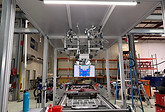

Layered Assembly Systems
Layered Assembly Verification
LM3 develops assembly verification systems by placing cameras, lighting, and sensors at key build steps to confirm the correct parts, fasteners, clips, labels, connectors, and subassemblies are present and properly positioned. PAQi captures each stage from a PLC, sensor, barcode, or operator trigger, then returns pass/fail results before the part moves forward.



Pick and Place
Systems
Vision -Led Robotic Pick & Place
LM3 develops pick and place systems using industry-leading 2D and 3D vision hardware, including SICK PLB series cameras for part localization and robotic guidance. Systems are configured around the part geometry, presentation method, calibration process, robot coordinates, and PLC communication so the robot can locate, pick, place, and verify parts reliably in production.


Automated Measurement
Dimensional Verifications
LM3 develops automated measurement systems using calibrated vision, lighting, 3D sensors, and profilers to verify dimensions, feature positions, edges, holes, and part geometry against production tolerances. Systems are configured around the part, presentation method, required accuracy, and machine-level result handling.

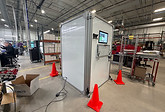

Inspection
Cells
Autonomous Inspection Cells
LM3 develops inspection cells around the part, defect, and production workflow, combining controlled lighting, camera placement, PAQi/QC Hero inspection logic, and machine communication to prove out reliable pass/fail decisions for critical components, assemblies, and part families.


Inspection Workbenches
Operator-Guided Inspection
LM3 develops workbench inspection systems by adding cameras, lighting, fixtures, sensors, barcode readers, and PAQi control logic directly to manual operator stations. The system captures images during the build or inspection step, verifies part presence, fasteners, clips, labels, orientation, or assembly conditions, then gives the operator immediate pass/fail feedback before the part moves downstream.


In-Line
Inspection
Production Line Inspection
LM3 develops in-line inspection systems by placing cameras, lighting, sensors, and PAQi control logic directly into the production flow. Inspections are triggered by PLC signals, sensors, encoders, or part position, allowing PAQi to capture images, check defects, orientation, features, identifiers, or assembly conditions, and return pass/fail results without removing the part from the line.


End-of-Line
Inspection
End-of-Line Quality Assurance
LM3 develops end-of-line inspection systems by placing cameras, lighting, barcode/OCR readers, 3D sensors, and PAQi control logic at the final production checkpoint. The system verifies assembly completeness, labels, identifiers, surface defects, measurements, and final product condition, then sends pass/fail results to PLCs, MES, reject gates, or operator review stations before packaging or shipment.

.png)

MoldView
Systems
Injection Molding Inspection
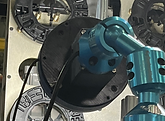
PAQi MoldView is built into the molding cycle by placing cameras and lighting at the mold, EOAT, or post-ejection inspection point. PAQi captures images from the press or robot trigger, checks for flash, short shots, misloads, deformation, ejection issues, and visible part defects, then returns OK/NOK results for routing, containment, or process feedback.


Proudly Servicing
_edited.png)


_edited.png)
_edited.png)