


System Hardware, Design & Validation
Cameras, lighting, sensors, fixtures, functional testing, validation, and lifecycle support for production systems
LM3 designs and supports the physical system layer required to make inspection, measurement, automation, and validation work reliably in production. This includes camera and sensor packages, lighting, fixtures, controller hardware, custom interfaces, functional test equipment, field wiring, and deployment support.
These systems are built around repeatable image capture, clean machine integration, serviceable hardware, production-ready validation, and long-term support. Whether LM3 is supplying a full machine, a vision subsystem, a test fixture, or an upgrade to existing equipment, the goal is to create hardware and support structures that can be installed, maintained, validated, and expanded over time.
Core Competencies
-
Camera, lens, lighting, and sensor package design
-
2D, 3D, profiler, thermal, and spectral device integration
-
Inspection geometry and field-of-view planning
-
Part presentation and repeatable image formation
-
Controller, HMI, networking, and station hardware packaging
-
Hardware layouts designed for installation, service, and future expansion

Cameras, Lighting & Sensors
LM3 selects and integrates the sensing hardware required to capture repeatable production data. This includes the cameras, lighting, optics, and sensor devices needed to make defects, features, identifiers, or measurements visible under real production conditions.
Hardware Options
-
USB3, GigE, smart, thermal, spectral, and 3D cameras
-
Lenses, filters, housings, and protective mounting hardware
-
Ring lights, bar lights, spotlights, RGBW lights, and diffuse lighting
-
Profilers, depth sensors, displacement sensors, and barcode readers
-
Fixed, enclosed, robot-mounted, and multi-camera sensing layouts
Engineering Use
LM3 uses these devices to control how the system sees the part. The camera, lens, lighting, working distance, field of view, and sensor type are selected around the inspection requirement rather than chosen generically. The goal is to create stable image or sensor data that can support AI inspection, rule-based vision, measurement, OCR, robotics, or functional validation.


Industrial Control Packages, Interface Hardware & Runtime Execution Infrastructure
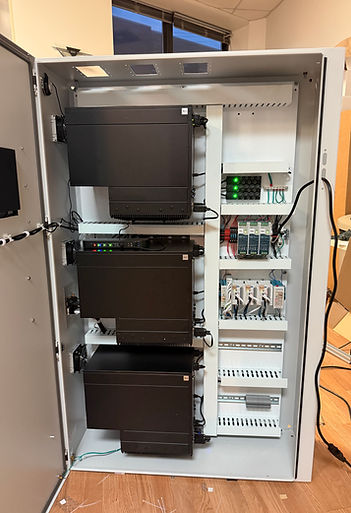
This section covers the hardware layer that allows LM3 systems to run as real production assets rather than isolated inspection setups. It includes the controller platforms, local operator hardware, interface devices, I/O architecture, and packaged station hardware required to manage acquisition, triggering, sequencing, communication, and runtime decision-making on the factory floor. Depending on the system, this hardware may be deployed as a compact local controller or as a larger cabinet-scale package with integrated HMI, network hardware, and higher-performance compute.
Hardware Options
-
PAQi controller packages
-
Industrial PC and edge compute platforms
-
GPU-enabled controller configurations
-
Compact local controller units
-
Panel-mounted controller packages
-
Cabinet-mounted runtime systems
-
HMI and local monitor packages
-
Breakout boxes and utility interface hardware
-
Discrete I/O hardware and field wiring interfaces
-
Network switches and communications hardware
-
Barcode scanner and identifier interface hardware
-
Light-control and peripheral-control hardware
-
Station-side power distribution and protected interface hardware
-
Remote I/O and machine-side interface panels
-
Runtime-ready packaged hardware for installation and service
Engineering Use
LM3 uses this hardware layer to turn the vision and inspection process into a deterministic machine-level function. These packages are used to coordinate cameras, sensors, barcode devices, operator controls, inspection logic, pass/fail handling, and communication with PLCs, robots, and downstream equipment. In lower-complexity applications, the runtime hardware may be packaged as a compact station controller with local I/O and a simple operator interface. In higher camera-count, higher compute, or more integrated systems, LM3 deploys larger cabinet-based hardware packages with GPU compute, integrated networking, HMI support, and broader machine-side electrical interfaces. The purpose of this architecture is to ensure the system is installable, maintainable, serviceable, and ready to operate reliably under real production conditions.


.png)
Custom Interface Hardware, Production Connectors, Cable Systems & Station-Side Field Devices
This section covers the custom hardware that physically links the inspection or validation system to the production environment. It includes the interface hardware, cable systems, connectors, station-side devices, and low-volume electromechanical packages required to distribute signals, power, triggers, runtime states, and operator interaction across the system. These elements are often what make the difference between a concept that works in isolation and a system that is durable, serviceable, and repeatable in production.
Hardware Options
-
Breakout boxes
-
Interface panels
-
Custom cable assemblies
-
Production connectors
-
Docking connectors
-
Test connectors
-
Field wiring hardware
-
Barcode and scanner interface hardware
-
Pushbuttons and operator devices
-
Stacklights and status indicators

Engineering Use
LM3 uses this hardware to create reliable physical connections between the controller, sensing hardware, machine, and operator. These components are especially useful in customer-specific stations, test systems, retrofit projects, and applications where standard hardware does not provide the durability, serviceability, or interface structure required for production use.


Core Competencies
-
Complete machine and system architecture
-
Process flow and sequence design
-
Mechanical, electrical, and controls planning
-
Vision, automation, and software integration
-
Operator workflow and HMI design
-
Part handling and station logic development
-
Functional requirement and scope definition
-
Multi-station and modular system design
-
PLC, robot, sensor, and field-device integration planning
-
Validation and process-control architecture
-
Runtime logic and machine-state coordination
-
Design for deployment, serviceability, and support


.png)
Complete Machine Architecture, Functional Flow & Production Sequence Development
LM3 develops complete system architectures by defining how the machine should function before detailed hardware and programming are finalized. This includes process flow, inspection and validation sequence design, operator interaction, part handling strategy, machine-state behavior, and the coordination between vision, automation, controls, and software. The result is a system structure that is technically sound, production-ready, and aligned with the real operating requirements of the application.
Competencies
-
Complete machine architecture development
-
Functional requirement and system scope definition
-
Process flow and sequence planning
-
Station logic and machine-state design
-
Part flow and handling strategy development
-
Inspection and validation flow design
-
Operator workflow and interaction planning
-
Multi-station and modular system architecture
-
Response logic for pass, fail, reject, and fault conditions
-
Integration planning across vision, controls, robotics, and software
Engineering Use
LM3 uses this engineering phase to define how a system should operate before it is built, programmed, or deployed. It is used to establish the sequence of operations, determine how parts move through the process, define what triggers each action, and organize how inspection, handling, operator actions, and machine control interact within one coordinated design. This work is especially important for systems that combine multiple technologies or require customer-specific workflows, because it creates the foundation for the mechanical, electrical, software, and controls design that follows.


Integrated Mechanical Design, Electrical Architecture & Machine Control Development
LM3 designs the core machine infrastructure required to turn a system concept into a buildable production asset. This includes coordinated mechanical layouts, electrical architecture, control logic, device placement, and software structure so the machine operates as one integrated system rather than as a collection of disconnected components. This work defines how the machine is built, how it is wired, how it is controlled, and how each subsystem interacts throughout the production cycle.
Competencies
-
Mechanical system layout and machine design
-
Electrical architecture and device planning
-
PLC and controls structure development
-
I/O and signal-mapping strategy
-
Sensor and actuator integration planning
-
Vision, motion, and controls coordination
-
Software logic and machine sequence planning
-
HMI and operator control integration
-
Panel, cabinet, and hardware layout planning
-
Design for serviceability, safety, and maintainability


Engineering Use
LM3 uses this phase to develop the actual machine framework that supports production operation. It is where the mechanical design, electrical layout, controls architecture, and software behavior are organized into one coordinated machine concept. This includes defining how the equipment should be constructed, how devices should be positioned and connected, how the control system should respond throughout the cycle, and how inspection, motion, operator actions, and machine logic should work together in practice. This work is especially important for custom machines, integrated inspection systems, retrofit equipment, and multi-technology systems where performance depends on strong coordination across all engineering disciplines.


.png)

Production Tooling, Part Presentation, System Packaging & Field-Ready Machine Structure
LM3 designs the physical structures that make a machine practical and repeatable in production. This includes tooling, nests, fixtures, part presentation methods, support structures, and overall machine packaging required to hold the process together mechanically. The objective is not only to make the system function, but to make it accessible, maintainable, and reliable for real operators, parts, and factory environments.
Competencies
-
Fixture and nest design
-
Part presentation strategy
-
Poka-yoke and mistake-proof tooling
-
Camera, lighting, and sensor support structures
-
Machine support frames and hardware packaging
-
Enclosure and guarding layout planning
-
Operator access and ergonomic design
-
Cable routing and hardware protection strategy
-
Design for maintenance and service access
-
Packaging for repeatable field deployment

Engineering Use
LM3 uses this phase to define how the machine is physically built around the process. It includes the tooling and presentation methods that stabilize the part, the support structures that hold sensing and machine hardware in the correct positions, and the packaging decisions that make the system practical to install, operate, and service. This work is especially important in custom systems where repeatability depends on strong mechanical presentation, controlled access, and a machine structure that supports both performance and long-term use in the field.


Core Competencies
-
System deployment and commissioning
-
Camera, lighting, and device calibration
-
PLC, robot, and I/O verification
-
Runtime bring-up and sequence testing
-
Inspection and process validation
-
Production-readiness and runoff support
-
Operator and maintenance training
-
Troubleshooting and issue resolution
-
Software, model, and configuration updates
-
Long-term service and lifecycle support

System Bring-Up, Installation Support & Production Startup Execution
LM3 supports the transition from engineered system to working production asset by guiding the deployment, startup, and commissioning process in the field. This includes bringing hardware online, verifying communications and interfaces, aligning cameras and lighting, confirming runtime behavior, and helping ensure the system is installed and operating as intended within the production environment.
Competencies
-
Installation and deployment support
-
Hardware bring-up and startup execution
-
Camera and lighting setup
-
PLC, robot, and I/O verification
-
Network and device connectivity confirmation
-
Runtime sequence checkout
-
Job and recipe configuration
-
Barcode and traceability setup
-
System calibration and baseline tuning
-
Production startup support

Engineering Use
LM3 uses this phase to move the system from design and assembly into active operation on the factory floor. It includes confirming that devices are connected properly, communications are functioning, triggers and runtime logic behave correctly, and the system is ready to run against real parts and live production conditions. This work is especially important for integrated systems where inspection, controls, operator workflows, and traceability all need to function together reliably before validation and handoff can begin.
System Validation, Runtime Verification & Readiness for Live Manufacturing Operation
LM3 supports the validation process required to confirm that a system is ready for real production use. This includes reviewing runtime behavior against customer requirements, verifying inspection or process logic on representative parts, confirming machine responses and traceability behavior, and helping ensure the full system is performing in a stable and production-ready manner before final handoff.
Competencies
-
Inspection and process validation support
-
Runtime verification on production parts
-
Pass / fail / fault behavior review
-
Sequence and machine-state verification
-
PLC, robot, and HMI response confirmation
-
Traceability and result logging verification
-
Barcode and job-handling validation
-
Edge-case and exception review
-
Runoff and acceptance support
-
Production-readiness assessment

Engineering Use
LM3 uses this phase to verify that the system performs reliably under the conditions it will face in production. This includes confirming that inspection results, control logic, operator interaction, and machine responses behave as intended across real parts, real sequences, and real operating states. The goal is to identify any remaining issues, finalize runtime behavior, and support a smoother transition into customer acceptance and live manufacturing use.
Operator Training, Ongoing Service Support & Long-Term System Continuity
LM3 supports the system beyond initial deployment by providing the training, technical support, and follow-on service required to keep it usable over time. This includes operator and maintenance training, troubleshooting support, software and model updates, configuration changes, and continued assistance as production needs, parts, or inspection requirements evolve.
Competencies
-
Operator training and system handoff
-
Maintenance and troubleshooting training
-
Runtime and job-changeover support
-
Remote and on-site technical support
-
Software and configuration updates
-
Model revision and deployment support
-
System optimization after launch
-
Spare and backup strategy support
-
Ongoing service and issue resolution
-
Long-term lifecycle continuity planning

Engineering Use
LM3 uses this phase to help customers operate, maintain, and improve the system after startup is complete. It includes building user confidence through training, supporting issue resolution in the field, and helping the system adapt over time as production changes. This is especially important for applications where long-term performance depends on controlled updates, continued troubleshooting access, and a support structure that extends beyond initial commissioning.


